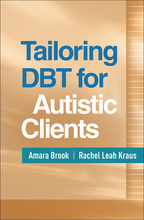
Tailoring DBT for Autistic Clients
Amara Brook and Rachel Leah Kraus
 Digital professor copy available on VitalSource once published ?
“An essential, timely contribution. Drawing on both professional expertise and lived experience, Brook and Kraus offer a comprehensive, accessible, and neuroaffirmative framework for adapting DBT for autistic clients. The book integrates foundational information about autism and neurodiversity with concrete, clinically useful examples of how to modify DBT skills and overall treatment delivery. Going beyond surface-level accommodations, this practical guide is a 'must read' for DBT clinicians committed to ethical, neurodiversity-affirming care.”

—Kiki Fehling, PhD, DBT clinician, speaker, and author, Northampton, Massachusetts
“Tailoring DBT for Autistic Clients is a rare gem—an insightful, wise, and deeply practical guide that DBT clinicians will turn to again and again. Brook and Kraus present a culturally competent and humble approach that is both comprehensive and easy to apply, making it invaluable for therapists at any stage of their careers. Offering deep insights and actionable strategies, this book meets a critical need.”
—Donna Henderson, PsyD, Neuropsychologist and Director of Autism Services, The Stixrud Group, Silver Spring, Maryland
“I can’t say enough about the richness of this manual for adapting DBT to the treatment of Autistic individuals. The authors walk us through a deep, multifaceted understanding of the experiences and needs of Autistic clients, only possible by virtue of extensive clinical and personal lived experience. They are very specific about how to tailor every aspect of DBT—session by session, skills module by skills module, and everything in between. The book appeals to clinicians to treat Autistic folks with respect, humility, and compassion, while remaining true to DBT principles and practices. This is a masterful synthesis that will ultimately help innumerable Autistic individuals around the world.”
—Charles Swenson, MD, Department of Psychiatry, University of Massachusetts Medical School
“This useful book fills a gap by illustrating the 'whats' and 'how-tos' of doing DBT in a neurodiversity-affirming way. In true dialectical fashion, Brook and Kraus synthesize acceptance and change throughout their work. At the same time as teaching neurodivergent clients the skills to navigate a world not designed for their brains, therapists must advocate for a more inclusive world. I recommend this book as essential reading for all DBT therapists.”
—Andrea Gold, PhD, Department of Psychiatry and Human Behavior, Alpert Medical School of Brown University
Table of Contents
I. Understanding Neurodiversity and Autistic Needs1. Introducing Neurodiversity
2. A Neurodiversity-Affirming Approach to DBT
3. Autistic Traits That Call for Tailoring DBT
4. Overview of Tailoring DBT for Autistic Clients: The ASCENT Model
II. Assessment and Treatment Planning
5. Neurodiversity-Informed Assessment
6. Collaborative Treatment Planning for Autistic Clients
III. Tailoring Individual Therapy
7. Setting Up Your Process and Space for Individual Therapy
8. Finishing Individual Therapy Pretreatment Tasks
9. Tailoring the Working Phases of Individual Therapy
IV. Tailoring Skills Training
10. Overview of Tailoring Skills Training: Things to Tailor
11. Pretreatment and Orientation to Group
12. Mindfulness Skills and Practice
13. Distress Tolerance Skills
14. Emotion Regulation Skills
15. Interpersonal Effectiveness Skills
V. Tailoring Other Components and Future Directions
16. Tailoring Coaching and Consultation Team
17. Conclusion and Future Directions
Appendix. Some of Our Favorite Resources for Learning More about Autism!
Glossary: Neurodiversity Lingo
References
Index
About the Authors
Amara Brook, PhD, ABPP (they/them), is Clinical Assistant Professor of Psychology at the University of Nevada, Reno, and has a private practice providing neurodiversity-affirming assessment and therapy. Dr. Brook's past roles include serving as Director of Postdoctoral Training and Dialectical Behavior Therapy (DBT) Team Coordinator at Kaiser and providing assessment and DBT in VA medical centers and schools. Their research and clinical interests include improving assessment for Autism and attention-deficit/hyperactivity disorder (ADHD) to be more accurate, affirming, and accessible, and tailoring DBT and related therapies to be more affirming and effective for Autistic and ADHD clients. Dr. Brook has published widely and frequently provides training and consultation to other clinicians around the world. Their website is www.flowps.com.Rachel Leah Kraus, LCSW-C (she/her), is a clinical social worker in private practice in Maryland. She offers neurodiversity-affirmative, DBT-informed treatment to individuals who struggle with complex trauma, dissociative disorders, borderline personality disorder, and/or obsessive-compulsive disorder on top of an Autistic, attention-deficit/hyperactivity disorder (ADHD), or co-occurring Autistic and ADHD (AuDHD) neurotype. Additionally, she offers executive function coaching to clients, as well as professional training, supervision, and consultation to clinicians around the world. Ms. Kraus has been providing DBT-informed treatment since 2008 in a variety of contexts, including schools, residential treatment facilities, hospitals, and community mental health clinics. Her website is www.krauspsychotherapy.com.